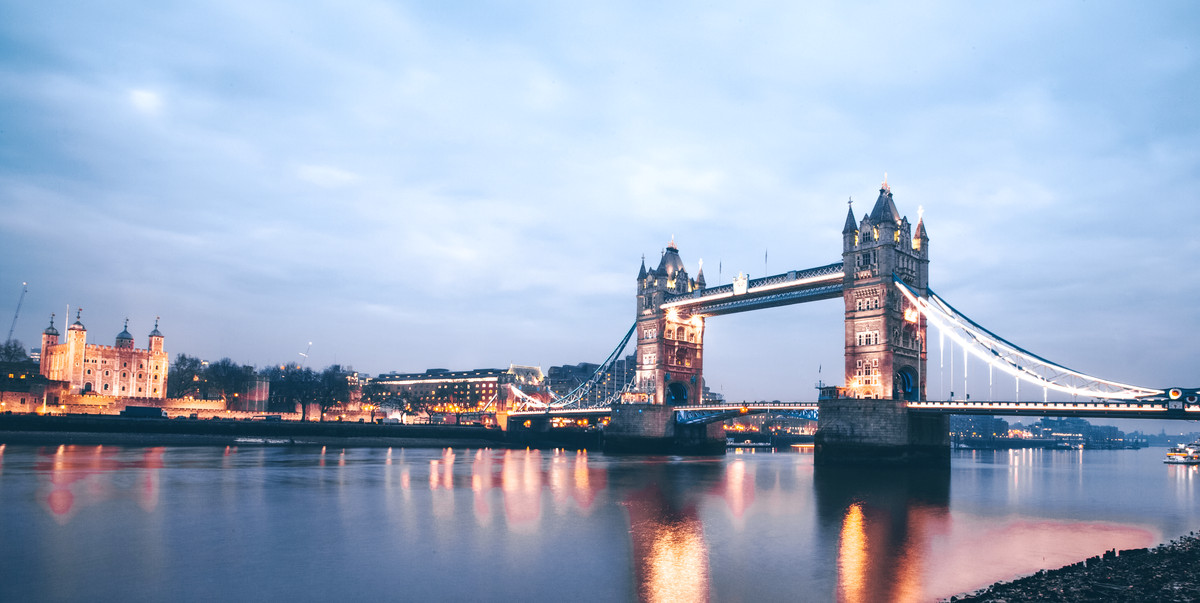
You’re looking at Tower Bridge, not London Bridge! Built between 1886-1894, this iconic Victorian Gothic masterpiece features twin 61-metre towers and bascules that lift to an 86-degree angle in just five minutes. Originally chocolate brown (Queen Victoria’s preference) and powered by steam engines, it’s now painted red, white, and blue, and opens about 800 times a year. The bridge has witnessed some incredible stunts and near-misses throughout its colourful history.
Iconic Design and Construction (1886-1894)
Eight years of dedicated engineering and architectural brilliance went into creating London’s most recognisable bridge. When construction of Tower Bridge began in April 1886, nobody imagined it would become such a global icon!
The bridge combines two clever designs, bascule (which allows the middle section to lift for ships) and suspension, all wrapped in stunning Victorian Gothic architecture that’ll catch your eye from miles away.
You’d be amazed by the materials used: over 11,000 tons of steel form the backbone, covered with beautiful Cornish Granite and Portland Stone.
The twin towers soar 61 metres above the River Thames, while the main span opens to an impressive 76-metre width. This engineering marvel cost about £1.2 million—money well spent on a bridge that’s still turning heads today!
The Bascule: How Tower Bridge Actually Works

While many tourists admire Tower Bridge’s Victorian Gothic façade, it’s the impressive engineering underneath that truly makes this landmark special!
Tower Bridge operates as a bascule bridge—think of a giant seesaw that lifts to let ships pass underneath. When it first opened, coal-burning steam engines powered the hydraulic system that raised these massive roadways.
Today, you’ll find a more modern electric and oil-driven system doing the heavy lifting.
Need to let river traffic through? No problem! Each bascule takes just five minutes to raise to a maximum angle of 86 degrees.
Originally, six huge accumulators stored energy for immediate lifting. Though Tower Bridge only opens about 800 times a year now, that’s quite a drop from 6,194 lifts in 1894!
Changing Colours
Tower Bridge isn’t just an engineering marvel—it’s also quite the fashion icon! Did you know the bridge has changed its outfit several times throughout history?
When first revealed in 1894, it sported a rich chocolate brown colour that Queen Victoria particularly fancied.
During the Second World War, the bridge received a practical makeover with battleship grey paint to help conceal it from enemy aircraft.
But its most recognisable look came in 1977 when it was repainted in patriotic red, white, and blue to celebrate the Queen’s Silver Jubilee—a colour scheme that continues to define its appearance today.
If you’re curious about the original colour, you’re in luck! You can still spot the historical significance of that first chocolate brown inside the bridge itself.
Memorable Incidents
Throughout its long history, the iconic London landmark has witnessed some truly jaw-dropping incidents that you wouldn’t believe!
Perhaps the most famous occurred in 1952 when quick-thinking bus driver Albert Gunter realised the bridge had opened beneath him. Rather than braking, he accelerated and jumped his double-decker across the growing gap – with all passengers escaping unharmed!
Tower Bridge has also attracted daring aviators. In 1912, a biplane piloted by Francis McClean flew straight through the bridge’s opening, while Frank Miller repeated this heart-stopping stunt in 1951 (though he earned himself a £100 fine!).
You might be surprised to learn the upper walkways were closed for over 70 years due to lack of visitors, only reopening in 1982 as part of the exhibition you can enjoy today.
Not London Bridge After All
A common misconception clouds many tourists’ minds when visiting London—this stunning Victorian masterpiece isn’t actually London Bridge!
You’ll often hear visitors pointing at Tower Bridge and exclaiming, “Look, it’s London Bridge!”—but they’re mistaken. London Bridge is actually a much simpler structure located upstream.
Tower Bridge, with its distinctive twin towers and suspension design, stands as one of London’s most iconic landmarks, while London Bridge has a more modest appearance.
Unlike London Bridge, which was famously sold and relocated to Arizona in the 1960s, Tower Bridge remains firmly in its original location, proudly representing London’s architectural heritage.
The Tower Bridge Experience

Visiting Tower Bridge offers five unforgettable experiences that combine history, engineering, and breathtaking views.
Start your adventure at the North Tower ticket office, where nearly 890,000 visitors began their journey in 2019 alone.
When you’re inside the Tower Bridge Exhibition, you’ll uncover films, photographs, and interactive displays that bring the bridge’s story to life.
Don’t miss the glass walkways installed in 2014 – standing 42 metres above the Thames provides a thrilling perspective of London!
Make sure you explore the Engine Rooms, where the original steam engines that once powered this Victorian marvel are displayed.
Educational workshops highlight the bridge’s historical significance and engineering genius.
It’s like stepping back in time while learning how this iconic landmark continues to connect Londoners today.
Tower Bridge in Popular Culture
Beyond the breathtaking views and fascinating machinery, Tower Bridge’s iconic silhouette has captured the imagination of filmmakers, artists, and storytellers worldwide.
You’ve likely spotted this London landmark in James Bond’s “The Man with the Golden Gun,” where it serves as a quintessential symbol of the city’s skyline not to mention the Spice Girls Movie.
During the 2012 London Olympics, you couldn’t miss Tower Bridge proudly displaying the Olympic rings, becoming the perfect backdrop for this global event.
In 1951, daredevil Frank Miller made headlines when he flew a plane between the bridge’s towers earning himself a £100 fine!
Interestingly, Tower Bridge is often confused with London Bridge in popular culture, despite their very different appearances.
You’ll even find it represented in video games like “Assassin’s Creed,” cementing its status as a cultural icon.
Frequently Asked Questions
Why Is It Called Tower Bridge?
You’ll find Tower Bridge gets its name from its proximity to the Tower of London. Its twin towers rise 213 feet above the Thames, reflecting the historic castle’s medieval architecture.
Were prisoners kept in Tower Bridge?
No, you’re confusing Tower Bridge with the Tower of London. Tower Bridge was never used to hold prisoners, it’s simply a roadway and pedestrian crossing over the River Thames.